Strength beside the trail
Outdoor movement is repetitive. Without foundational muscular strength around your hips and ankles, repetitive steps can lead to nagging aches. You don't need a gym pass—your local park offers all the resistance you need.
The role of strength for outdoor runners and walkers
Whenever your foot hits the ground, your body requires stability across three distinct joints: the ankle, the knee, and the hip. If your gluteus medius (the muscle on the outside of your hip) is underactive, your knee tends to collapse slightly inward with each step. Over thousands of strides, this rotational twist irritates the patellar tendon and the iliotibial (IT) band.
By pausing for five to eight minutes at a sturdy wooden bench during your walk or interval session, you wake up dormant stabilizers, balance your posture, and build protective armor for your cartilage.
Four essential park-bench movements
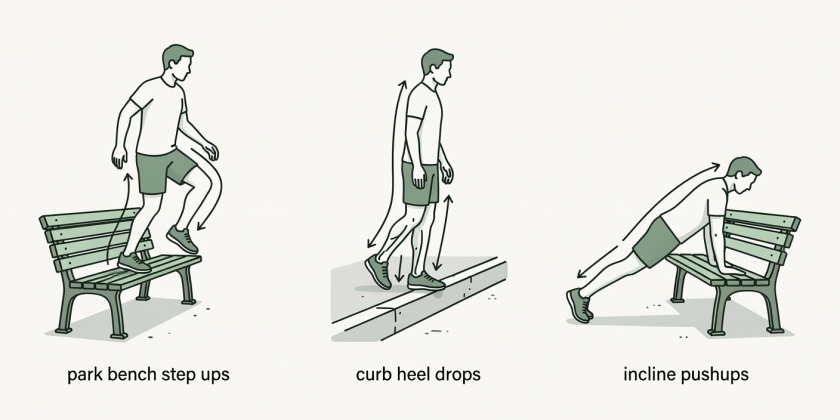
Bench Step-Ups
Place your full right foot firmly on the bench seat. Press through your right heel to stand tall, bringing your left knee up gently. Step down softly. Complete 8 to 10 repetitions per leg. Builds quad power and single-leg balance.
Incline Plank / Push-Ups
Place your hands shoulder-width on the bench backrest. Keep your body in a straight line from crown to heels. Hold for 20 seconds, or perform 6 controlled push-ups. Keeps your core stable so your torso doesn't fold while walking uphill.
Curb Heel Drops
Stand on the edge of a curb or stone step with the balls of your feet, letting heels hang off slightly. Rise up onto your toes, then slowly lower your heels below the step edge. 12 repetitions strengthen the Achilles and calf tendons.
Sit-to-Stand Squats
Stand in front of the bench, feet shoulder-width. Hinge at your hips and lower yourself until your thighs touch the wood, then press immediately through your midfoot to stand back up without using hands. 10 controlled reps.
When and how often to perform these drills
You do not need to turn your outdoor session into an exhausting boot camp. The most sustainable approach is to treat these movements as a natural middle milestone of your route:
- Warm-up walk: 10 minutes of brisk, comfortable movement to bring blood flow to major muscle groups.
- Bench pause: 5–7 minutes moving gently through 1 or 2 sets of each exercise without rushing.
- Return home: 10–15 minutes of relaxed walking or run-walk intervals.
Two sessions per week containing these four basic movements are more than enough to improve joint integrity, reduce lower back stiffness, and make every uphill incline feel noticeably easier.
Understanding how different trails affect your joints
Combine your new strength with mindful surface selection. Pavement, dirt trails, and grass put distinct loads on your legs.
Discover route selection principles →