Walking with a little more purpose
Walking is frequently underestimated as a tool for physical conditioning. When executed with deliberate posture, consistent cadence, and attentive breath, brisk walking trains the cardiovascular system with negligible impact stress.
The anatomy of an efficient stride
Most people associate walking with passive ambulation: eyes directed toward their mobile phone screen, hips slouching backward, feet dragging flat against the concrete. While casual strolls offer genuine stress-relief benefits, purposeful fitness walking requires deliberate engagement of your posterior chain.
To shift an ordinary stroll into an aerobic workout, focus on three specific postural anchors:
-
01
Tall Spine & Level Gaze
Keep your eyes focused ten to fifteen meters ahead on the path rather than right down at your toes. This naturally stacks your cervical vertebrae directly over your shoulders and avoids compressive strain on your neck.
-
02
Compact Arm Pendulum
Bend your elbows at approximately 90 degrees rather than keeping your arms pinned rigid at your sides. Swing gently from the shoulder socket. The natural rhythm of your arms drives your step frequency without extra muscle work.
-
03
Heel-to-Toe Rocker
Allow your heel to make gentle first contact, rolling your weight smoothly through the arch and pushing off actively through the big toe. Avoid overreaching forward with long, heavy strides.
Cadence over stride length
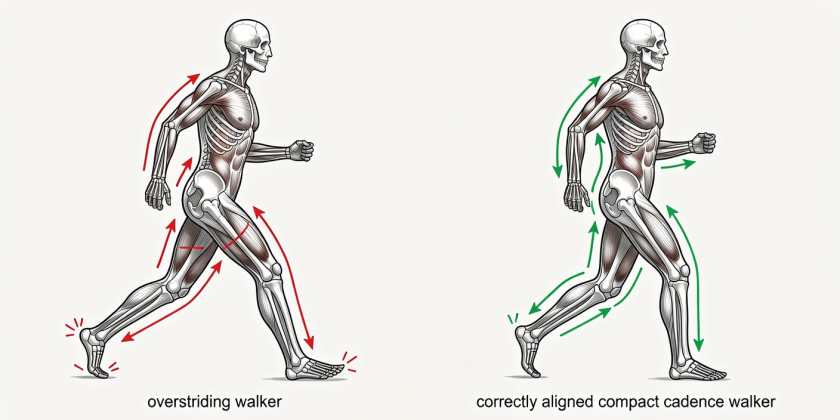
The most frequent beginner mistake in brisk walking is trying to walk faster by extending the front leg further forward. Overstriding acts like a mechanical brake. Every time your heel impacts the pavement far ahead of your center of mass, counter-reactive forces travel directly up into your knee joint and lower spine.
Instead of stretching forward, maintain a compact, natural stride and increase your cadence—the number of steps you complete each minute. Aim for a turnover of roughly 105 to 120 steps per minute. Music playlists set to 110–120 beats per minute or a pocket metronome app can help you find that smooth, frictionless momentum.
Constructing a four-week walking progression
If you are returning to exercise after months or years of sedentary living, do not rush. Give your tendons, ligaments, and plantar fascia time to thicken and adapt. Consistency matters far more than heroics.
| Week | Frequency | Session Length | Focus Note |
|---|---|---|---|
| Week 1 | 3 days / week | 15–20 minutes | Establish comfortable routine; monitor footwear comfort. |
| Week 2 | 3–4 days / week | 20–25 minutes | Introduce 90-degree bent arm drive; practice level gaze. |
| Week 3 | 4 days / week | 25–30 minutes | Maintain steady continuous pace; incorporate mild inclines. |
| Week 4 | 4 days / week | 30–40 minutes | Consolidate base; prepare body for run-walk intervals if desired. |
Pay close attention to how you feel sixty minutes after the walk finishes. If you notice localized sharpness in your Achilles or knees, hold at your current weekly volume rather than stepping up. True conditioning respects tissue healing timelines.
Ready to add gentle running intervals?
Once you can comfortably sustain thirty minutes of purposeful walking without residual foot fatigue, you are ready to experiment with structured run-walk intervals.
Continue to the Run-Walk Guide →